

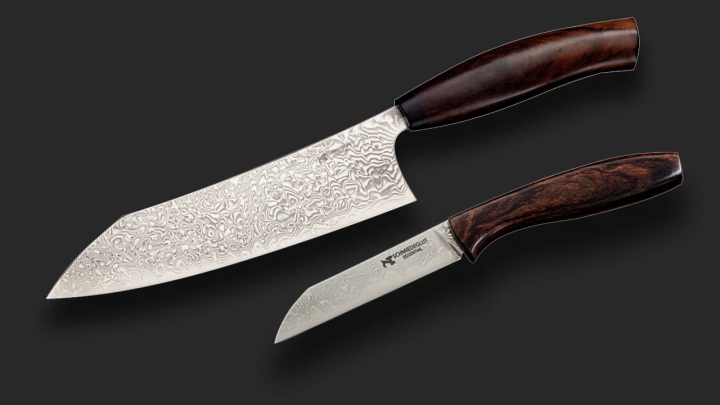
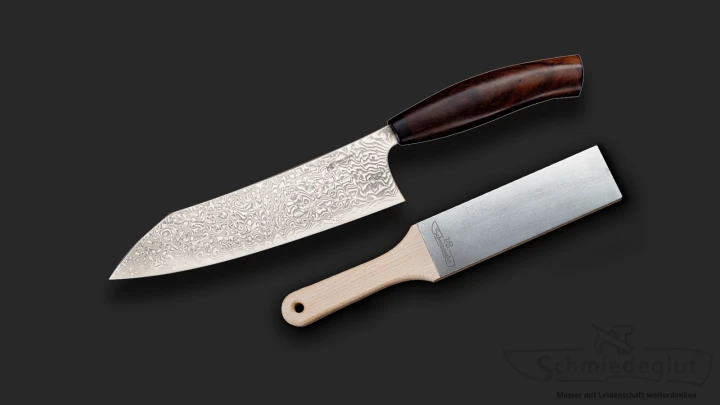
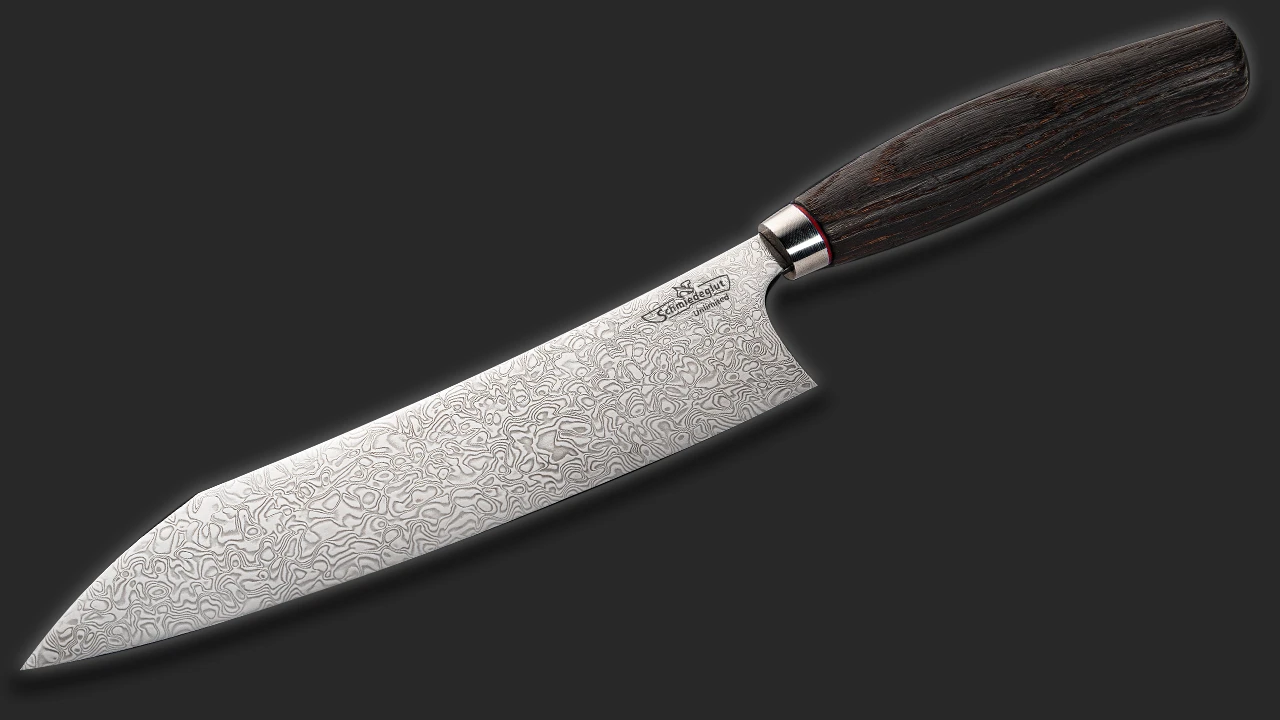
Our Santoku knives
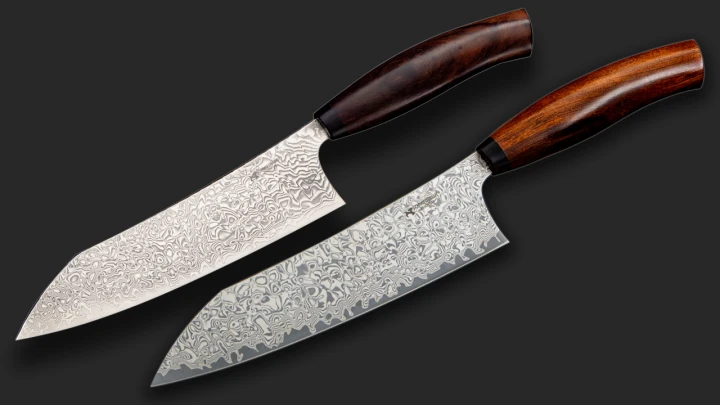
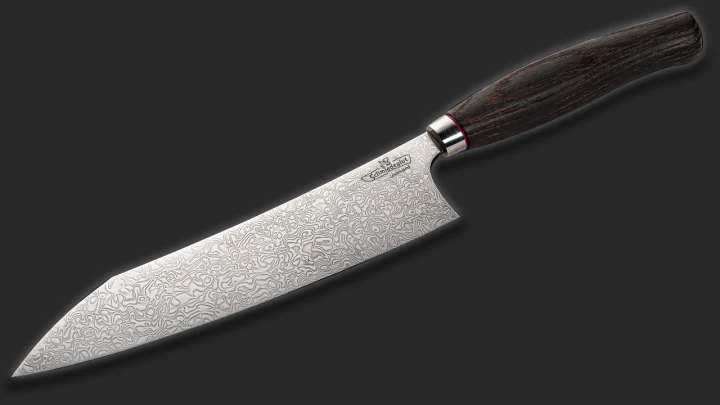
The Santoku knife originates from Japan. Unlike a classic chef's knife, it has a much thinner blade and therefore less wedge effect when cutting. The steel is optimized for maximum razor sharpness and the Santoku chef's knife is used to cut vegetables, meat, and fish on a cutting board.
The wide blade rests on the fingers and can be used for both chopping (pressure cut) and rocking (swing cut) motions. Thanks to our experience as knife makers and our collaboration with professional chefs, every Schmiedeglut Santoku knife is also very light, perfectly balanced, ergonomically shaped, and has cleanly rounded edges. To ensure a long service life and sustainability, we have made the V-grind as flat as possible from the back to the cutting edge.
Sharpening kitchen knives to razor sharpness
How do you sharpen a knife to razor sharpness in 30 seconds?
How can you avoid unnecessary wear and tear to increase the service life? Which angle for which knife and how do you maintain the angle? Which tools and why? How can I avoid expensive mispurchases and how do I regrind serrated blades? We share our expertise and help you finally achieve razor-sharp knives!
Santoku
The Santoku knife: What is it used for? Professional chef's knives must not only be sharp, but also suitable for their intended use. In Japan, a versatile universal knife for chopping a wide variety of foods is called a Santoku knife.
Meat, fish, and vegetables are the main tasks of the Santoku, as it is known for its uncompromising sharpness thanks to its fairly thin blade and flat cutting angle. The Santoku knife is instantly recognizable by its characteristic blade shape, which is also known as "Santoku" in Japanese as an all-purpose kitchen knife.
The blade has no tip and is rounded at the front of the back. The knife is so wide that the blade extends well beyond the handle, providing space for your fingers so that they are not obstructed by the cutting board.
Compared to a meat knife, the Santoku is very light and is primarily designed for what is known as pressure cutting. Unlike rocking the blade, the chef lifts the knife and cuts the ingredients with just a slight cutting motion. The knife is guided with the fingers using the wide blade. This allows the sharp Santoku to achieve an astonishing speed when cutting.
When buying a Santoku knife, it is important to note that the blade is balanced in the index finger, the cutting edge is ground as flat and thin as possible, and that the steel has a minimum Rockwell hardness of 60 HRC so that the thin cutting edge does not bend when in contact with the cutting board.
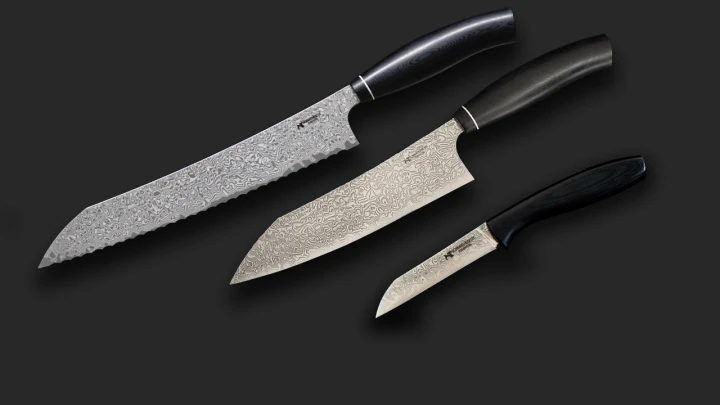
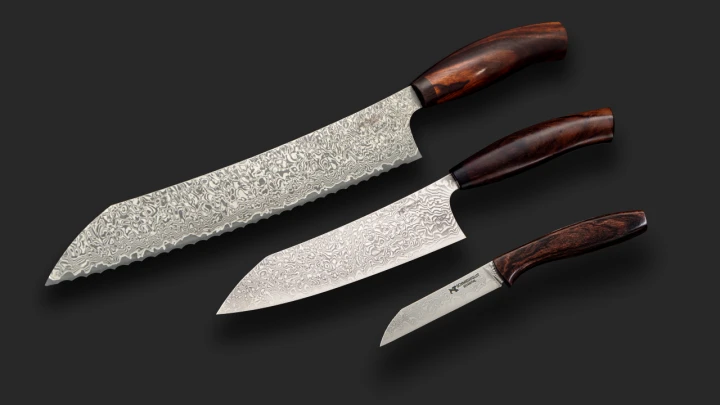
For hard crusts, woody herbs, or fine detail work, the cook supplements the Santoku with a large bread knife and a small utility knife (Kneipchen).


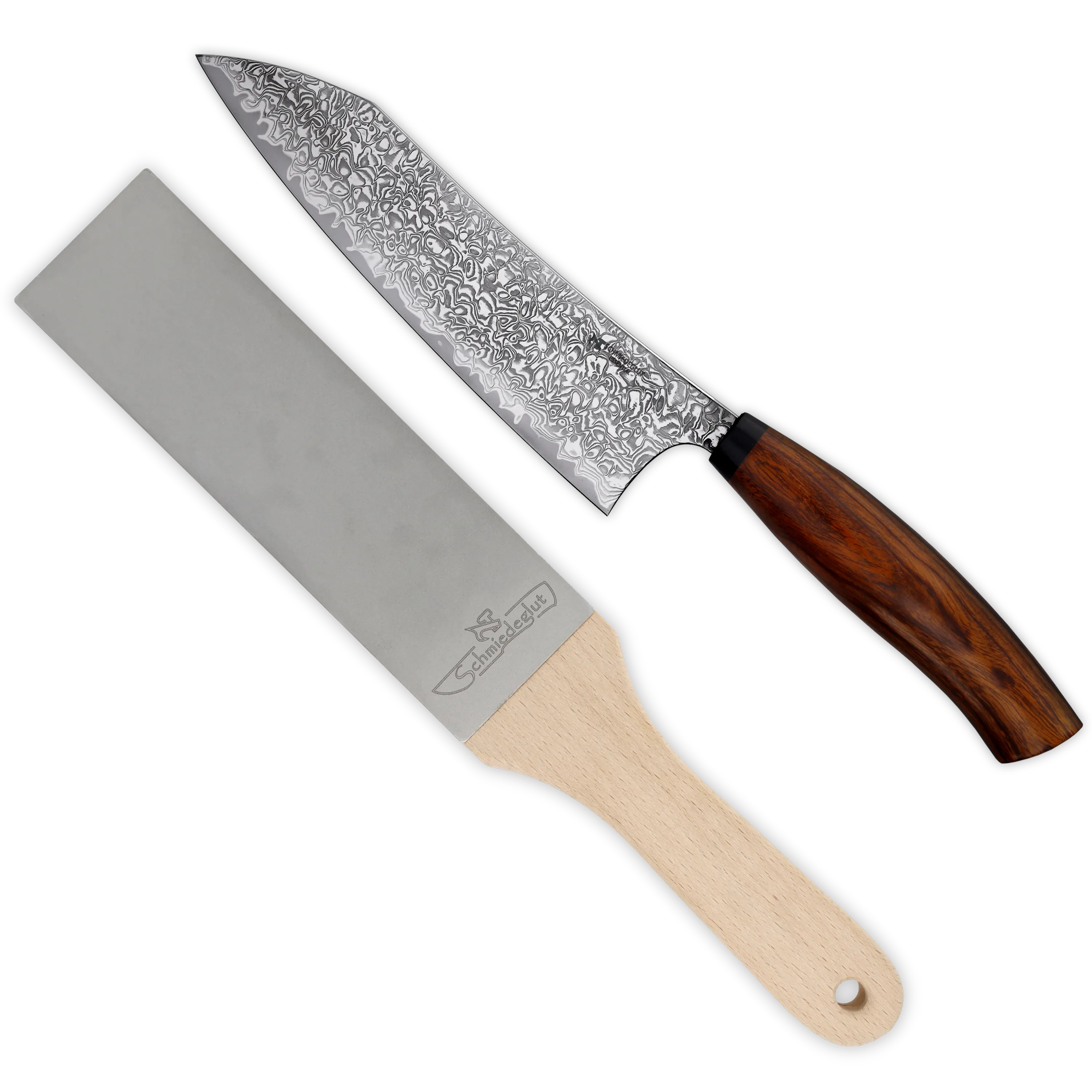

Schmiedeglut Essential - Kitchen knife set in G10 (polished & etched)
